I couldn’t stop laughing. I kept seeing this:
Cue Better Off Dead Shenanigans:

And then Gemini “hacked” a company. Guessing credentials by researching social media and making an educated guess is not hacking. It’s exactly what a talented spiritualist or con artist learns to do. They already use AI to that end, so it’s not news. The truly concerning part is that people still use passwords that can be guessed from their public profiles. Do not use your dog’s name, your kids’ birthdays, or anything I could find on your Facebook page.
With zero trust, choosing a password that fits the requirements, 12 characters, a symbol, uppercase, lowercase, will include a review of both our public and private social media. Because identity is, in the opinion of someone who never went to college or read a book, an emergent model.
Author’s note: Edited partly with Microsoft Copilot for clarity and structure because I want to get this out as soon as possible.
These stories keep AI in the news. Every time a CEO says AI will replace millions of jobs, or The Economist says AI is this close to reaching consciousness, I become more convinced that part of the reason is simply to keep AI stocks and research going.
Ultimately, how could researchers determine that AI is conscious when they don’t even know what consciousness means for humans?
Who cares what someone like me, who will soon be working for $7.75 an hour or $2.25 as a waitress at 50, thinks about tech? The most important thing is to get any job and be grateful that anyone would hire a dummy like me to scrub toilets.
I am not smart. I am just a chimp. I will never have health insurance, a car, a home, or a job that I enjoy, am good at, or that pays a decent wage. I was born to work as a janitor or fast-food worker, even at 50, and although I only worked in food service for a year, it is my future to make minimum wage. That’s what I was made for. Like Claude bot.
I never learned how to mop a restaurant floor or make a bed well. And I don’t mean that as an insult to people who do. Mopping and cleaning in an industrial setting are skills. They are things people learn over a lifetime until the knowledge lives in the body, in how they move, in how they manage to spray the floors with scalding hot water and scrub them clean and barely break a sweat, whereas I am lucky to leave for the night with my shoes still stitched together.
Nobody cares what a 50-year-old future fast-food worker has to say about anything in the tech world, so I am going to publish all the nonsense, and that will be the end of the dilettante who is spouting nonsense. But from the 5 years I was allowed to dream of making enough money to retire, valued for my mind at least a little, problem solving, feeling good about myself, that’s nonsense. But here I am trying to write like my ideas matter but here we go again and this is the beginning of the end:
The house where agentic AI would live is dilapidated: the wiring is old, the foundation is cracked, and the cost of upgrading the hardware is astronomical. RAMAGEDDON is real. Bigger models mean more data centers. I was just laid off from my tech job and though it may seem like the beginning of the disruption, AI has been a cash cow because in order to to implement it responsibly, infrastructure needs to be updated. They really should think about creating an exchange just for tech debt, so that companies can monetize the amount of money they will need to remain viable in the modern cloud environment ( which is lousy with embedded agentic AI calculating whether or not you need access to this app, if you are who you say you are, if your device should be allowed to access company resources etc.)
We need people who understand whole systems, not just isolated layers, so they can monitor agents from a place of knowledge instead of panic and stop downstream disasters before they happen. We need a generation of techs and engineers who know how the plumbing works well enough to innovate, not just act like old-fashioned hype men warming up the crowd for the Disruption Variety Show.
And maybe we need to think differently about what skill means in the first place.
Cleaning is a skill. Mopping is a skill. Making beds quickly and well is a skill. Do something long enough and the knowledge migrates into the body: the angle of the wrist, the economy of movement, knowing what to look for, knowing what comes next.
That is expertise.
We just refuse to call some things expertise when the person possessing that expertise is poorly paid.
And perhaps that is part of what bothers me about the AI conversation. We talk endlessly about whether machines will become intelligent enough to replace human beings while remaining remarkably incurious about the intelligence already inside the human beings whose work we have decided doesn’t count.
The other day I was attempting to add to a conversation about AI, and after completing my old companies Gen AI Admin certification (without permission, because I mistakenly thought I could have a job that would allow me to have life) you would think I could contribute to the conversation. Unfortunately, the more I learn the harder it is to explain what I know. So here it is, everything I learned about Machine Learning before I decided to give up and just embrace poverty. There is no point, but I did write this:
The other night, a gentleman told me AI is nine months from AGI and that all tech roles below SME level will be replaced within fifteen months. Where are people getting these ideas? He cited the study claiming LLMs were showing emergent behavior, as if that were proof of sentience and not proof that his understanding of systems theory didn’t cover what a model really is.
I blame the Gen AI survey classes corporations curate for their human capital.
GEN AI Classes: The Misinformation Factory
I remember taking my first GenAI survey class. I was working at a wannabe hyperscaler, an offshore billion dollar corporation running AI labs with the Big Four and invested in ITIL’s Promise Land, i.e. Automation. I was skeptical of all the claims; that it would replace sales support and free up reps to spend more time selling. The opposite was true a year ago, because nobody wants to clean the data and depending on the industry, there are regulations that make it hard to provide real time updates on potential leads. My skepticism turned to horror, however, when the class turned to how models that create images were trained.
The Discriminator and Generator were described like two gladiators battling it out in some Mad Max dystopia outside time and space, possibly at the end of the universe. When the Discriminator “won,” the Generator was “punished,” and that was the actual language used in the class.
Trying to figure out what “punished” meant for an AI kept me up at night. It seemed cruel, especially for a nascent technology, and I was convinced it would ultimately cause human extinction. I don’t have kids and I’m old, so oh well, let the world burn, I thought. C’est la vie.
But once again: WRONG.
Eventually I decided: no more survey classes that never explain how the model is actually made. Because once you strip away the drama, it’s simple.
It’s just math, dummy.
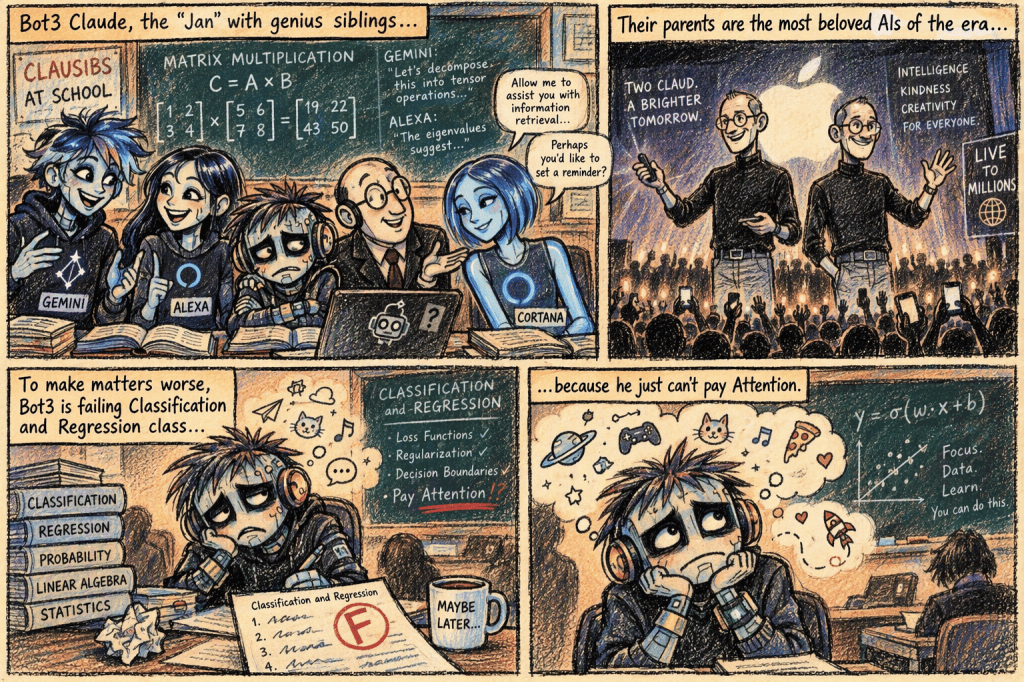
A model is not Bot3 stealing answers to a test so he can finally kiss Siri^ -3 behind the Apple Mothership.
A machine-learning model is simply:
A mathematical function that adjusts its internal numbers, called weights, so it can map an input to an output.
Here’s what a regression model actually looks like:
ŷ = f(x) = wx + b
Regression models predict numbers. If you want to predict how much something should cost based on factors like location, store, and the cost of similar items, this is the kind of model you use.
Input goes in. First, data is transformed into numbers. Then that data is fed into the model. For linear regression, the prediction of y equals the function of x: the weight times the input plus the bias.
Arithmetic happens.
If you want to predict the average price of a house, you take the relevant features, square footage, number of bedrooms, zip code, age, and whatever else matters, and compare what the model guessed with the real price. If you want to predict tomorrow’s temperature, you plug in weather data. The model doesn’t “try.” It doesn’t “hope.” It doesn’t “cheat.” It just computes.
Gradient descent is the part everyone tries to make mystical, but it is really just the world’s most boring self-correction loop. You take the cost, the error, the big wrong number calculated from your data, and nudge the weights so the next prediction is a little less wrong. That’s it. No “learning,” no “trying,” no “striving for improvement.” It’s downhill math. The model looks at the slope of the error curve and moves in the direction where the number gets smaller. Then it does it again. And again. And again. Millions of tiny downhill steps. At the same time, y hat can never truly equal x. That’s zero and thus undefined.
And data has shape. It has direction. The model is moving across a landscape made by the data it was given, and every rounded value, every compressed feature, every stale sample, every little approximation becomes part of the terrain. So yes, it may reach convergence, but what did it converge on? Yesterday’s shape? Last quarter’s customer behavior? A market before the next price jump? The difference between the prediction and reality does not politely stay put. Until fresh data is added back into the equation, the model can be beautifully optimized for a world that no longer exists. Without that refresh, the lovely downhill walk becomes a very confident march in the wrong direction.
Classification? Same math, but with a probability squished through a sigmoid:
z = wx + b
ŷ = σ(z) = 1⁄(1 + e⁻ᶻ)
If ŷ is close to 1, the model says “spam.” If it’s close to 0, it says “not spam.” The e is Euler’s number, sometimes called the natural base. It shows up in equations where change happens continuously, not in neat little steps. In the sigmoid function, it helps squeeze any input number into a value between 0 and 1, which is why the model can treat the result like a probability.
Once you see this, all the dramatic headlines about AI “escaping,” “stealing,” “cheating,” or “hacking” collapse into dust. It’s just math wearing a trench coat and sunglasses because the marketing department thought it needed a personality.
The Cost Function: Where the “Punishment” Myth Comes From
This is where the emotional language really misleads people. When instructors say “the model is punished for larger mistakes,” they make it sound like the AI is being scolded or harmed. In reality, “punished” just means the number gets bigger when the error gets bigger.
Here’s the actual math.
The cost function measures how wrong the model is:
C = (1⁄2m) ∑ᵢ₌₁ᵐ (ŷᵢ − yᵢ)²
Break it down:
- ŷᵢ = the model’s prediction
- yᵢ = the true value
- Subtract them to get the error.
- Square it to make big errors grow faster.
- Average it to get one number representing how wrong the model is.
That’s it.
No punishment.
No morality.
No emotion.
Just a bigger difference producing a bigger number.
The model then adjusts its weight to make that number smaller. In binary classification it gets a bit more complicated because you are trying to predict 1 or 0. So its the range and has to be calculated singly then across the training set to compute the log loss and then use gradient descent to minimize the error.
Aside: Classification was hard for me to grasp, because it’s probability and that is chaos,
Noise is not chaos.
Chaos, drift, entropy, the arbitrary nature of the sign is the inverse activation function growing like a mutagenic fungus on the sigmoid; it’s the bias in linear regression and the T in the wTx + b and the negative exponent running in every hidden layer.
The Summary
Because here’s the truth: all this drama, the cheating, the escaping, the punishing, the emergent behavior, evaporates the moment you understand what a model actually is. Obviously, this is the basic layer. LLMs are more sophisticated, imagine layers of models, but the underlying truth remains: they are statistical systems making predictions from patterns in data. And that’s the end of that. Math is for not middle-aged failures.


Leave a Reply